top of page
Kingsley Wu
Chemistry
About Chemistry
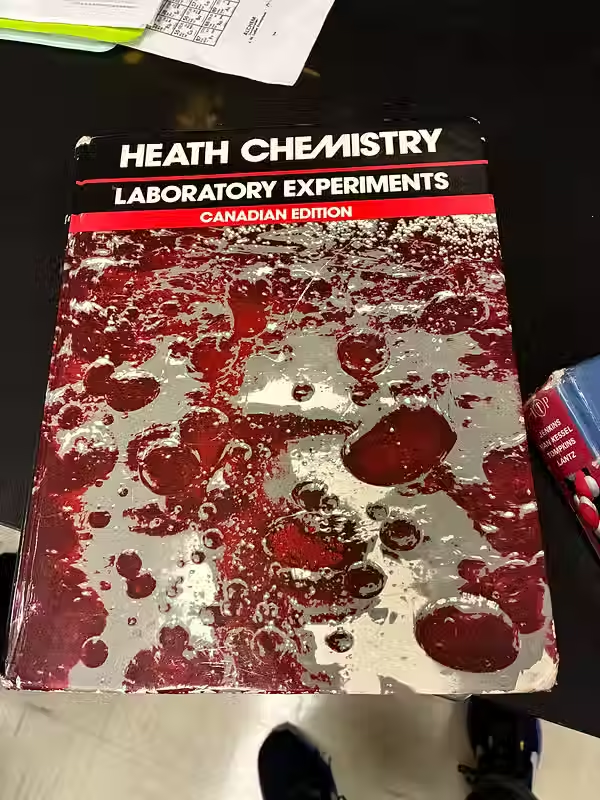
In the chemistry course, students will learn a lot of courses about chemistry. For example, the DNA of organisms, the energy changes in the rearrangement of atoms, the conversion of energy may affect organisms and the environment, and the Big Bang theory can be used to explain the formation of the universe.
This course has a lot of professional words to describe things that we don't usually see, such as substances, elements, compounds, mixtures, and chemical properties
What will students do?
Some students will observe the scientific problems they are interested in, and also put forward hypotheses, plans, and implementations about the problems. They can make experiments on this problem, and they usually create independent plans and work as a team. And choose the appropriate scheme for research to facilitate the obtaining of available data.
What they need to do is to assess risks, choose suitable equipment, experience the local environment, abide by security rules in analysis, and find and analyze the relationship between associations, trends, and variables in the data.


Planning And Experiment
Regarding planning and conducting experiments, students should consider the various problems they may encounter in the experiment. Including what tools do you need to carry out, measure and test? How do you rely on genetic data for research? How do you know the principle of acid and alkali reaction to produce salt and water?
Analyze And Process
As for how to analyze and process data and various information, you need to define goals, collect data, clean data, select and apply appropriate analysis methods (such as comparative analysis, regression analysis), interpret the results and visualize them, and finally make decisions based on the analysis results.
For example, before starting the experiment, you know clearly what questions you need to solve or answer through data. Regarding data cleaning, you need to identify and process the error values, abnormal values and missing values in the data. This may include deleting inaccurate data points or using statistical methods to fill in missing values, etc.
Evaluation
In chemical evaluation, we can conduct it from multiple levels, including risk assessment of chemical substances, which focuses on their impact on the environment and health; discipline assessment, which measures the overall level of chemical disciplines; and chemical professional education assessment, which examines the ability and employment of graduates. The evaluation methods are divided into experimental research, literature and data analysis, and evaluation system.
Conclusions
As for how to draw conclusions, we need to apply the knowledge and concepts of chemistry to come to the same conclusion as the answer. Finally, there is the analysis of causality. Each conclusion has its own applicable conditions. Before using it, you should carefully review the questions and judge whether you can use concepts and knowledge to answer them quickly.


Why we need learn Chemistry?
Learning chemistry is essential because it provides a deeper understanding of the world around us, from the food we eat to the technology we use. It is a foundational science that connects to other fields like biology, physics, and medicine, and offers valuable skills in analysis, research, and problem-solving that are applicable to a wide range of careers, including those in medicine, environmental science, engineering, and pharmaceuticals.
Images


bottom of page