top of page
Kingsley Wu
Is this legal? The facts about Trump's use of National Guard troops
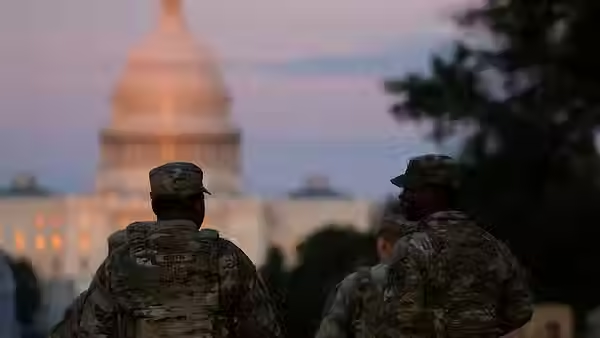
Members of the National Guard patrol the National Mall in Washington, D.C., on Sunday, weeks after U.S. President Donald Trump ordered them into the city. (Daniel Becerril/Reuters)
Baltimore, Boston and Chicago appear high on U.S. president's list for deployment
David Michael Lamb · CBC News · Posted: Sep 10, 2025 1:00 AM PDT | Last Updated: September 10
After the Trump administration deployed thousands of National Guard troops, first to Los Angeles in June, then to Washington, D.C., last month, the question has been how much further the U.S. president will go, and whether he has the legal authority to do it.
Trump has justified the moves by saying those cities are flooded with violent crime, alleging the mayors and governors are unwilling to do anything to fix it. Mayors and governors have responded by saying Trump's actions are not only unwanted, but illegal.
Trump has claimed recently that Washington is now "safe," touting the deployment as a template for other cities.
Can he do that?
There is a crucial difference between the National Guard in Washington and any other city Trump might deploy it. The U.S. capital is a district, not a state, so it has fewer rights and powers. The National Guard there is under the control of the president, whereas a state's National Guard is controlled by the governor.
(When Trump declared a crime emergency in D.C. on Aug. 11 and deployed the National Guard, he also invoked the Home Rule Act, giving him the power to take over the city's police force for 30 days.)
There are now more than 2,200 troops in D.C., more than half from states, all with Republican governors, which agreed to assist by sending their own National Guard members. The deployment has been extended until Nov. 30, though there are reports it could be further extended to the end of the year.

Members of the Ohio National Guard patrol a Washington subway station on Monday. More than half of the troops in the capital were sent from Republican-controlled states. (Daniel Becerril/Reuters)
D.C. Attorney General Brian Schwalb has filed two lawsuits against the deployment. One says the troops are being used illegally for law-enforcement purposes and that their presence is an illegal military occupation. It also notes that National Guard troops are not trained in law enforcement and are not accountable to the local population, as police are.
Schwalb warned in a statement that the deployment in his city is only the prelude. "It's D.C. today but could be any other city tomorrow."
What about outside D.C.?
In the states, it's not as straightforward for Trump. A state-controlled National Guard can usually only be "federalized" if the governor asks, or under a few other conditions. The president can do it to combat an insurrection, domestic violence or an invasion, but the definitions of those terms are open to interpretation.
Did it reach those levels in June, when Trump federalized and sent 4,000 the California National Guard troops into L.A. to support immigration agents? The administration says yes. The governor and others say no.

Members of the California National Guard are deployed outside a complex of federal buildings in Santa Ana, Calif., on June 18. (Mike Blake/Reuters)
The Los Angeles deployment was ruled illegal by a federal court, where a judge said it violated the 19th century Posse Comitatus Act, which prohibits military troops from being used for domestic law enforcement (unless Congress authorizes it, which has not happened).
The judge also warned that if the practice spreads to other cities, it would amount to creating a national police force, with the president as its chief.
The judge also warned that if the practice spreads to other cities, it would amount to creating a national police force, with the president as its chief.
The Trump administration said it would appeal the ruling, and is so far undeterred by it. Trump has said repeatedly in recent weeks that he intends to send the National Guard into many cities, including Baltimore, Boston, New Orleans and most menacingly, Chicago.
'War' on Chicago?
Trump said last week that Chicago is the "murder capital" and "worst and most dangerous" city in the world, though according to the FBI, its murder rate is not even close to the worst. Chicago ranks 29th among U.S. cities with populations of 500,000 or more; Memphis and Detroit are at the top.
Still, Trump says Chicago's crime is out of control, and has suggested the city can't handle the situation without federal help.
But Mayor Brandon Johnson says crime is down dramatically, noting that in April, Chicago had the fewest homicides since 1962. He says murders, shootings, robberies and carjackings are all down by double digit percentages compared to recent years.
Then, last weekend, Trump significantly increased his threat — posting a picture featuring himself in an Apocalypse Now meme, he said Chicago was "about to find out why it's called the Department of WAR." (Trump renamed the Department of Defence on Friday, although Congressional approval is needed for it to be official.)
Illinois Gov. J.B. Pritzker said Trump "is threatening to go to war with an American city," calling him a dictator and saying the state would not be intimidated.
The next day, Trump partially walked back his comments, but not his overall threat to send in the National Guard. He said he wasn't going to war on cities but will "clean them up so they don't kill five people every weekend. That's not war, that's common sense."
ABOUT THE AUTHOR
Senior Producer
David Michael Lamb is a senior producer with CBC News in Toronto.


bottom of page